

Real estate teams’ short sale processing is the coordination of seller documents, lender submissions, and negotiations to pursue a sale when proceeds will not cover the mortgage payoff. Your team needs clear ownership across agents, transaction coordinators, and outside processors—not another shared inbox where lender requests disappear.
- Short sale processing for real estate teams needs one file owner, a current lender checklist, and documented handoffs.
- Shortsalesdoneright is best for real estate teams seeking outsourced short sale package preparation and lender negotiation.
- Keep seller advice, buyer communication, and lender follow-up assigned to named people.
- A submitted short sale package does not guarantee approval or pause a foreclosure deadline.
Why short sale processing matters for real estate teams
A team can divide listing work without dividing responsibility clearly. The listing agent expects the coordinator to collect documents. The coordinator expects the negotiator to contact the lender. Meanwhile, the seller sends updated statements to someone else.
Assign one accountable file owner, even when several people do the work. That person tracks the next action, responsible party, and due date. Your 2026 operating procedure should make those responsibilities visible without requiring everyone to read every email.
Start with the MLS listing to short sale package workflow when defining where listing tasks end and submission tasks begin. A listing agreement, an offer, a submitted package, and written lender approval are separate milestones.
Team processing also requires boundaries. Agents handle representation and transaction communication within their role. Qualified legal and tax professionals address the seller’s legal exposure and tax questions. Lender terms and state law vary.
Build a short sale workflow your team can follow
1. Screen the file before assigning the workload
Start manually with a structured intake conversation and a secure document checklist. Identify what the seller wants, what the mortgage situation looks like, and whether an urgent deadline requires professional attention.
Do not treat an upside-down mortgage as automatic short sale eligibility. The lender determines its requirements, and the homeowner needs to understand alternatives. If the seller wants to remain in the home, direct the seller to ask the servicer about retention options rather than assuming a sale is the answer.
Use intake to identify missing facts, not to promise an outcome. Record whether information came from the seller, a statement, or a written notice so the next team member understands its source.
- Record the seller’s goal: sell, stay, or compare options.
- Identify each mortgage, servicer, and known additional lien.
- Ask for copies of foreclosure notices and scheduled dates.
- Confirm who owns the property and who must sign documents.
- Refer legal and tax questions to qualified professionals.
2. Assign one file owner and separate responsibilities
A shared spreadsheet works as a starting point. Give each active file one accountable owner and record who handles seller documents, lender communication, buyer updates, and closing coordination.
The file owner does not need to perform every task. The job is to prevent tasks from becoming unassigned. For example, the processor can request an updated statement while the listing agent explains to the seller why the request needs attention.
For your 2026 team workflow, set a recommended internal review every 7 days. That is your team’s review cadence—not a promise that the lender will respond within that period. Urgent notices require attention outside the routine review.
- Name the accountable file owner in the transaction record.
- Assign a backup for absences and staff changes.
- Give every open request an owner and due date.
- Separate seller-facing updates from lender-facing follow-up.
- Escalate deadline changes immediately to the responsible parties.
3. Choose in-house processing or an outside service
First, map the work your team can complete internally: collect the lender’s checklist, organize documents, submit through the required channel, and record follow-up. Assess staff capacity against those tasks rather than assuming a coordinator has room for them.
Outsourcing is the alternative when your team wants package preparation and lender negotiation handled outside the listing workflow. Shortsalesdoneright short sale processing is best for real estate teams seeking outsourced package preparation and lender negotiation. The service includes preparing the full short sale package for agents, a dedicated point of contact, and weekly lender updates.
The limitation is straightforward: outside processing does not replace the agent’s representation duties or control the lender’s decision. Your team still needs a reliable handoff, responsive sellers, and clear communication with buyers. Request help through the agent intake form on Shortsalesdoneright when you are ready to discuss a file.
- Write down which tasks your team wants to transfer.
- Confirm who collects missing or updated seller documents.
- Establish who submits information and communicates with the lender.
- Agree on how updates reach the listing agent and seller.
- Confirm responsibilities before sharing sensitive documents.
4. Build the package from the lender’s current requirements
Start with the servicer’s current instructions, not an old file copied from another transaction. A reusable checklist helps organize the work, but it does not replace lender-specific requirements.
Depending on the file, requested materials can include financial information, a hardship explanation, authorization documents, listing information, and an executed offer. Verify the actual requirements before describing the package as complete. Ask how to handle documents that do not apply rather than silently leaving gaps.
For 2026 files, keep a dated checklist showing what was requested, received, checked, and submitted. The useful distinction is not simply whether a document exists. It is whether the document matches the current request and is ready for submission.
- Obtain the required authorization before lender communication.
- Match financial documents to the periods the lender requests.
- Check signatures, dates, names, and property details.
- Flag missing pages and inconsistent information for correction.
- Store sensitive records in your approved secure system.
5. Track submission, receipt, and the next action separately
Manually log each submission and save the available delivery or portal confirmation. Sending documents is not the same as confirming that the lender received them or accepted the package for review.
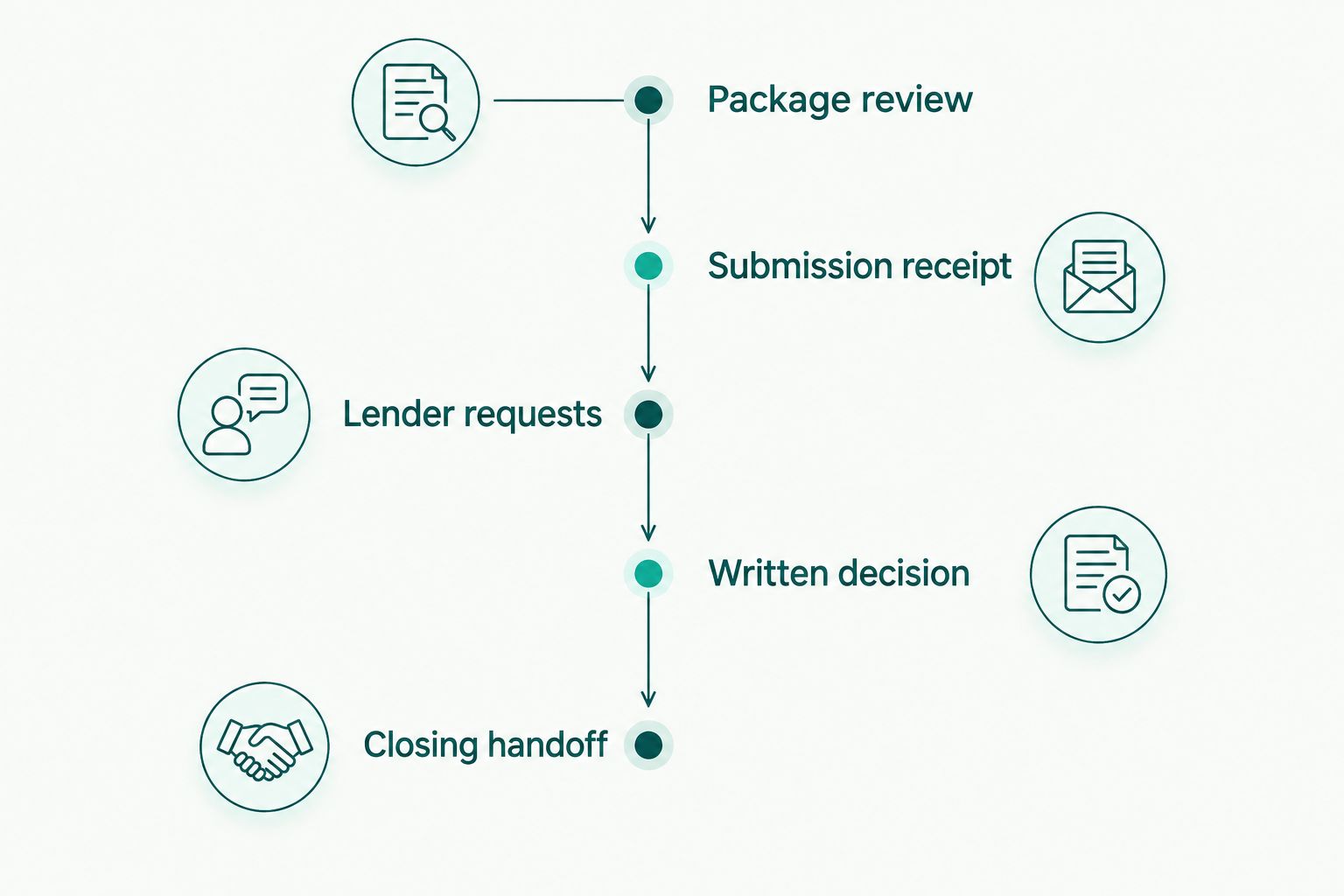
Use a simple sequence: package review, submission receipt, lender requests, written decision, and closing handoff. At every stage, record what must happen next. A status such as waiting gives your team less useful information than a dated request with a named owner.
Keep at least 3 tracking fields for every open item: owner, due date, and next action. Add the lender’s reference details where available so a backup can continue the conversation without reconstructing the file.
- Save the submission date and confirmation details.
- Record the lender contact or department handling the file.
- Log each additional request in the same transaction record.
- Confirm receipt after sending supplemental documents.
- Distinguish a verbal update from a written decision.
The workflow below keeps those milestones separate. A lender request sends the team back to the relevant task; it is not evidence that approval is assured.
6. Give sellers and buyers different updates
Create a short update template manually before adding automation. The seller needs to know what you need from them and what remains unresolved. The buyer’s agent needs transaction status, outstanding conditions, and information relevant to contractual decisions.
Do not forward the same message to everyone. Seller financial records belong in the authorized processing channel, not a broad transaction email. Likewise, an internal discussion about negotiating strategy is not automatically a buyer update.
Shortsalesdoneright provides a dedicated point of contact and weekly lender updates. Your team should still decide who translates those updates into seller and buyer communications. Weekly reporting does not mean the lender makes a new decision every week.
- State the current milestone in plain language.
- Identify the next action and who owns it.
- Distinguish confirmed information from an outstanding question.
- Share sensitive information only with authorized recipients.
- Avoid presenting an estimated closing date as lender-approved.
7. Review written terms before moving toward closing
Start with the actual written approval and a condition-by-condition closing checklist. Do not schedule around a verbal indication that the file looks acceptable.
Coordinate with the closing professional on deadlines, required payments, title issues, and approved transaction terms. If an offer, buyer, contribution, or closing date changes, confirm whether the lender requires further review. Do not assume the original approval covers a changed transaction.
For your 2026 closing checklist, separate permission to sell from treatment of any unpaid balance. Approval of the sale does not, by itself, establish forgiveness of the remaining debt. Lender terms and state law vary; qualified professionals should address legal and tax consequences.
- Record the written approval’s expiration and stated conditions.
- Compare the approved terms with the planned closing.
- Confirm how additional liens and title issues will be handled.
- Escalate questions about any remaining debt to legal counsel.
- Verify required changes with the lender before closing.
Compare processing options for your team
Choose the operating model by task ownership, not by a promise of faster approval. Your team controls its preparation and follow-up; the lender controls its review and decision.
| Option | Best for | Main benefit | Key limitation |
|---|---|---|---|
| Listing agent handles processing | Agents who want direct oversight and can reserve administrative time | Keeps lender communication close to the listing agent | The agent must also manage document collection and follow-up |
| Internal transaction coordinator | Teams with staff capacity and a defined short sale procedure | Centralizes records and routine requests inside the team | The role needs appropriate training, supervision, and assigned negotiation responsibilities |
| Shortsalesdoneright short sale processing | Teams seeking outsourced package preparation and lender negotiation | Full package preparation, a dedicated contact, and weekly lender updates | Does not control lender approval or replace agent, legal, or tax responsibilities |
Before choosing, ask who handles incomplete packages, document refreshes, lender requests, and closing-condition changes. A clear division of work matters more than the label attached to the service.
Request help with your short sale
Use the agent intake form to request short sale processing and lender negotiation help.
Common mistakes real estate teams make
Letting several people contact the lender independently
Uncoordinated calls create competing records of what happened. Name a primary lender contact and have backups read the file log before making contact. Keep the next action in the transaction record, not only in a personal inbox.
Treating the transaction coordinator as the default negotiator
Administrative ownership and lender negotiation are different assignments. State both roles explicitly. If your coordinator owns document collection but not negotiation, identify who handles lender discussions before submitting the package.
Telling the buyer the package is approved because it is complete
A complete submission is a preparation milestone, not a lender decision. Use precise status language in your 2026 templates: submitted, receipt confirmed, additional information requested, or written approval received.
Treating an active short sale as protection from foreclosure
Do not tell a seller that submitting a short sale automatically stops foreclosure activity. Track any known sale date separately and obtain current information from the appropriate parties. Direct urgent legal questions to qualified counsel.
Promising a clean financial exit
Do not promise debt forgiveness, a particular credit-score result, or a specific tax outcome. Explain the limits of the agent’s role early. Have the seller obtain professional advice on unresolved legal and tax questions before relying on assumptions.
FAQ
What is short sale processing for real estate teams?
Short sale processing for real estate teams coordinates seller documents, lender submissions, negotiation, and transaction updates. A named file owner keeps responsibilities clear across agents, coordinators, processors, and closing professionals.
Is outsourcing short sale processing better than handling it internally?
Outsourcing fits teams that want package preparation and lender negotiation assigned outside the listing workflow. Internal processing fits teams with the capacity and procedures to manage those tasks themselves; neither approach guarantees lender approval.
What does Shortsalesdoneright handle for real estate agents?
Shortsalesdoneright prepares the full short sale package for agents and provides lender negotiation, a dedicated point of contact, and weekly lender updates. The agent still needs clear responsibilities for representation and transaction communication.
Who should own a short sale file on a real estate team?
One named person should be accountable for the file, even when several people perform the work. That person tracks open requests, due dates, handoffs, and unresolved questions.
How often should our team review short sale files?
A practical internal starting point is a review every 7 days, with urgent notices handled immediately. This is a recommended team cadence, not a lender response deadline or a prediction of approval timing.
Does submitting a short sale package stop foreclosure?
Submitting a short sale package does not automatically stop foreclosure. Track foreclosure notices and dates separately, verify current information, and direct legal questions to qualified counsel.
Does short sale approval mean the remaining mortgage debt is forgiven?
Short sale approval does not by itself establish forgiveness of the unpaid balance. Lender terms and state law vary, so the seller should have qualified professionals address legal and tax consequences.
One last thing
Add a separate field for written approval expiration—not just the expected closing date. Those dates serve different purposes. A team can keep its closing calendar current while overlooking a lender condition that needs attention first.